
All-on-4 vs All-on-6 Dental Implants
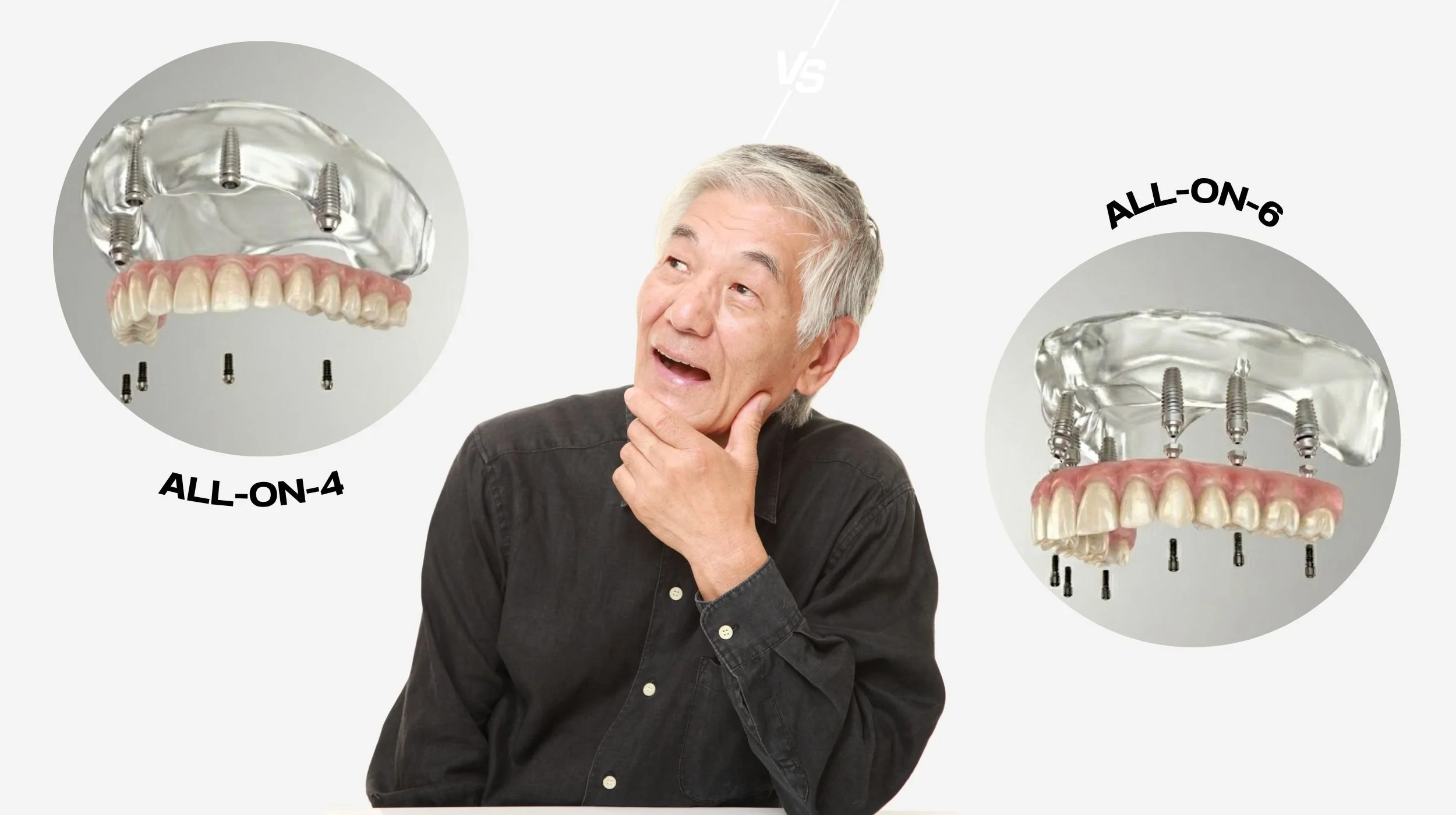
For patients missing most or all teeth, All-on-4 and All-on-6 dental implants are two commonly recommended full-arch solutions.
Both options provide fixed, non-removable teeth, but they differ in design, support, and clinical indications.
Understanding these differences can help you make a more informed decision before treatment.
What Do All-on-4 and All-on-6 Have in Common?
Both techniques are designed to replace a full arch of teeth using dental implants.
They share several key characteristics:
Fixed prosthetic teeth (not removable dentures)
Improved chewing efficiency and stability
Better speech compared with removable dentures
Designed for patients with multiple missing teeth
The main difference lies in how many implants are used to support the prosthesis.
Key Difference: Number of Implants
All-on-4 uses four implants per jaw
All-on-6 uses six implants per jaw
This difference affects load distribution, bone requirements, and long-term biomechanical support.
Comparison: All-on-4 vs All-on-6
| Factor | All-on-4 | All-on-6 |
|---|---|---|
| Implants per arch | 4 | 6 |
| Bone requirement | Lower | Higher |
| Load distribution | Good | More evenly distributed |
| Stability under bite force | High | Very high |
| Indicated for | Reduced bone volume | Adequate bone support |
When All-on-4 May Be Recommended
All-on-4 may be suitable for patients who:
Have limited bone volume
Want to avoid extensive bone grafting
Need a streamlined treatment approach
Have moderate bite forces
By angling the posterior implants, All-on-4 often maximizes existing bone and reduces the need for additional surgical procedures.
When All-on-6 May Be the Better Option
All-on-6 may be recommended when:
Bone volume and density are sufficient
Bite forces are strong
Long-term load distribution is a priority
Maximum stability is desired
Using six implants allows forces to be spread across more support points.
Does All-on-6 Last Longer Than All-on-4?
Both All-on-4 and All-on-6 can provide long-term, predictable outcomes when properly planned and maintained.
Longevity depends more on:
Implant placement accuracy
Prosthetic design
Oral hygiene
Regular professional maintenance
Rather than the number of implants alone, case selection and planning are the most critical factors.
How Dentists Decide Between All-on-4 and All-on-6
Dentists consider multiple factors, including:
Bone quantity and quality
Jaw anatomy
Bite force and chewing patterns
Overall oral health
Long-term functional goals
Advanced imaging and digital planning are essential to select the most appropriate approach.
Summary: All-on-4 vs All-on-6
Both All-on-4 and All-on-6 are reliable full-arch implant solutions.
The decision is individualized and based on anatomical, functional, and long-term considerations rather than a one-size-fits-all rule.
A comprehensive consultation is necessary to determine which option best suits your condition.